Family 22 · To drawing
Optical Coating
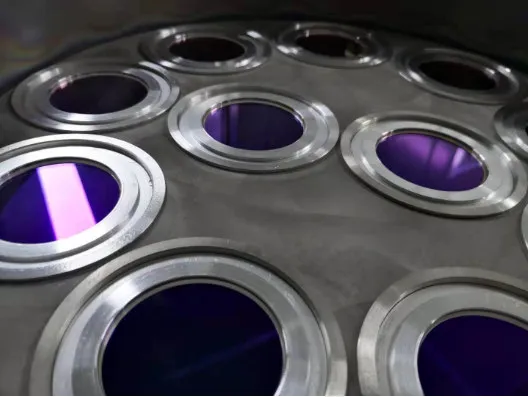
Thin-film coatings control how a surface reflects, transmits, absorbs and polarizes light. By setting the thickness and composition of each layer, we tune a part for the wavelengths and angles you use. All coating is done in-house.
- Fig.
- 22
- Coating
- In-house
- Quality
- ISO 9001
- Custom
- To drawing
- Since
- 1965
- Made in
- Roorkee
What it does · where it’s used
- More transmission and less glare with AR coatings
- Mirrors and beam splitters with reflective coatings
- Pass or block chosen wavelengths with filter coatings
- Control polarization with polarizing coatings
Six coating families.
- 22.A
Anti-reflection (AR)
Reduces reflection at a surface and raises transmission, for brighter, clearer images. Used on camera lenses, filters and spectacles.
- 22.B
Reflective (metallic)
Aluminium or silver films raise a surface’s reflectivity, for mirrors and beam splitters in telescopes, laser optics and photonic devices.
- 22.C
Dielectric mirror (HR)
Stacks of dielectric layers use interference to reflect chosen wavelengths strongly and others weakly. For lasers, resonators and filters.
- 22.D
Filter
Transmit some wavelengths while blocking or attenuating others. For spectroscopy, fluorescence microscopy and colour photography.
- 22.E
Beam-splitter
Divide an incoming beam into two or more beams at a designed ratio. For interferometers and imaging systems.
- 22.F
Polarizing
Change or select the polarization state of light. For polarizing microscopes, 3D glasses and LCDs.
Specify yours.
Start from a catalogue part or from your own drawing.
AMaterial
- Optical glass (BK7-class crown, flint)
- Fused silica / fused quartz
- Sapphire
- CaF₂
- BaF₂
- MgF₂
- Silicon (Si)
- Germanium (Ge)
- Zinc sulphide (ZnS)
- Zinc selenide (ZnSe)
- Nd:YAG crystal
- Other UV and IR materials
BCoatingIn-house
- ARAnti-reflection
- Al · AgMetallic mirror
- HRDielectric mirror
- Filter
- Beam-splitter
- Polarizing
CMade to your drawing
Send your drawing.
A drawing or a short spec is enough. We quote to it.
- Dimensions and tolerances
- Material and coating
- Surface quality
- Quantity
Quote for optical coating.
Tell us the part, material, coating and quantity, or send a drawing. We reply with a quote.